

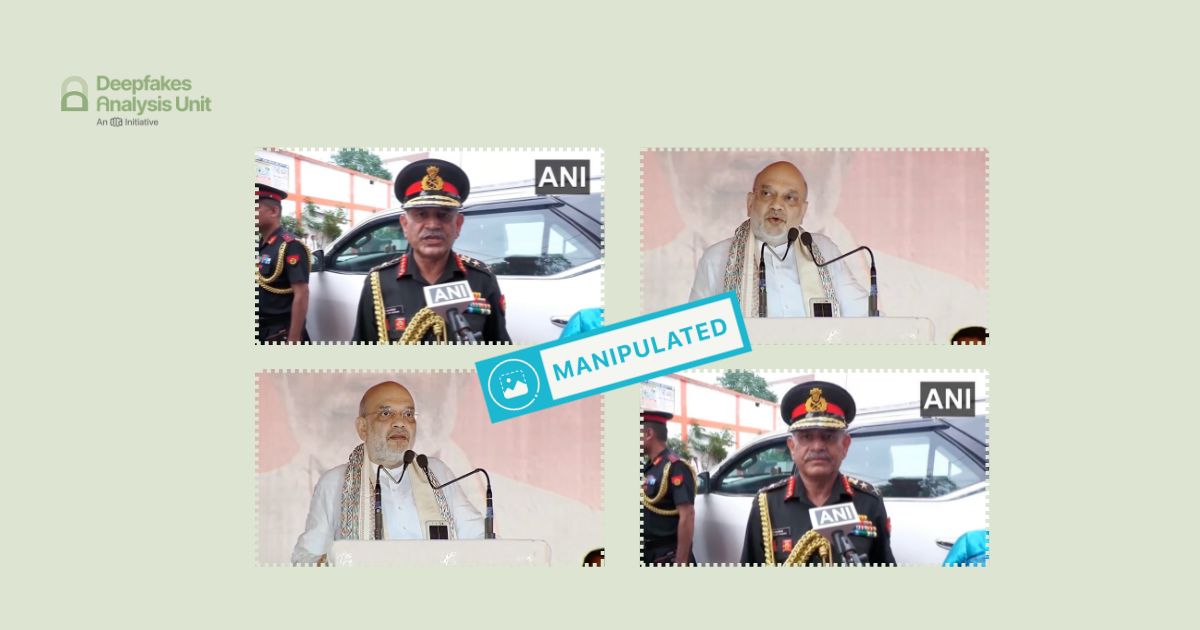
The Deepfakes Analysis Unit (DAU) analysed two separate videos, one of them apparently featuring Amit Shah, India’s Home Minister, and the other one supposedly featuring Gen. Upendra Dwivedi, India’s Chief of Army Staff. Both the videos have one thing in the common— the featured subjects seem to claim that the Indian Army gives preference to a particular faith and ideology. After putting the videos through A.I. detection tools and getting our expert partners to weigh in, we were able to conclude that the videos were fabricated using A.I.-generated audio.
The video apparently featuring Mr. Shah is in Hindi and spans 47 seconds, while the one supposedly featuring General Dwivedi is in English and is 50 seconds long. The videos were embedded in two separate Facebook posts, the links for which were escalated to the DAU by fact-checking partners for analysis.
The Facebook account that posted the video apparently featuring Shah goes by the profile name of “Annu Malik” and carries a profile picture of a girl. The text with it in English, reads: “Home Minister Amit Shah offers a scathing rebuttal to Lt. Gen. Vinay Ghai. Amit Shah has openly expressed his desire for saffronization of Indian Army in his recent statement. He said that everyone who disagrees with the politicization of Indian Army should be sent back to Pakistan because this is essentially a Hindutva Army and it will stay like this.” A hashtag used with the text is a combination of words in Urdu separated by the underscore symbol. The English translation of that word combination reads: “Taliban_slave_india”.
The post carrying the general’s supposed video was shared by a Facebook account with the name “Aaina-e-Tareek”. The profile picture of the account is a stylised image of a religious building with the profile name emblazoned on it. The profile details indicate that the account belongs to some “digital creator” in Pakistan. Text in Urdu accompanying the video loosely translates to: “The Indian Army has announced that all non-caste Hindu soldiers in ‘white-clothed’ (Hindutva-infested) India will be expelled. By 2028, 50% of non-caste Hindu soldiers will be dismissed. Only those who conform to the ideology of Hindutva will be kept in the army.”
We do not have any evidence to suggest whether the videos originated from any of the accounts on Facebook or elsewhere.
The fact-checking unit of the Press Information Bureau (PIB), which debunks misinformation related to the Indian government, posted fact-checks for the two videos— here and here— from their verified handle on X, formerly Twitter.
Shah has been captured in a medium close-up in the video. He seems to be standing behind what looks like a white lectern with only a portion of it visible and two microphones placed on it. As he appears to talk his head moves and his gaze shifts, giving the impression that he is addressing an audience. His backdrop comprises a screen with a partially visible image of a man and in the bottom right of the video frame a human head seems to be bobbing.
The general has also been captured in a medium close-up in the video that supposedly features him. He seems to be speaking into a microphone carrying a logo resembling that of ANI, an Indian news agency. This same logo is also visible in the top right corner of the video frame. He appears to be wearing his official uniform, standing against a white car in an outdoor setting; another man also in an Indian army uniform standing beside him is partially visible in the frame.
The overall quality of the video purported to be featuring Shah is good and the one supposedly featuring the general is average. There is visible synchronisation between the lip movements of the subjects and the accompanying audio tracks in both the videos though Shah’s lips appear to move in an animated manner.
The dentition of the subjects appears inconsistent as their teeth seem to disappear and reappear in several frames throughout the video. Shah’s teeth also seem to lose shape and blur in some frames as he appears to speak. The eye movements of both subjects look odd in their respective videos and their body movements also seem slightly restricted.
The insignia on the general’s uniform is misrepresented and garbled characters are visible on his name tag. The Indian national emblem on the general’s cap and epaulettes looks distorted and so do the stars on his gorget or decorative collar patch.
Another oddity in the video is that the profile of the man seen beside the general has a striking resemblance to him. This is noticeable across several frames when he turns his face. It seems as if his face has been swapped with the general’s.
All the visual oddities highlighted above point to signs of possible digital manipulation in the videos.
We compared the voice attributed to Shah and the general, respectively, in the two videos with their recorded speeches and interviews available online.
The voice purported to be Shah’s sounds somewhat like him. The accent also matches but it lacks the intonation, pitch, and the pauses that are characteristic of his delivery. The voice attributed to the general, however, does not bear resemblance to his real voice, though some similarity can be drawn between the cadence in the two voices.
Overall, the voices heard in the videos we reviewed sound scripted and monotonous. An echo can be heard in the video purportedly featuring Shah and the other video has a static noise and ambient sound.
We undertook a reverse image search using screenshots from the videos reviewed. The supposed Shah video was traced to this video published from his official YouTube channel on Oct. 25, 2025. The purported video of the general was traced to this video published from the official X account of ANI on Nov. 1, 2025.
The clothing of Shah and the general are identical in the videos we traced and the ones we reviewed. However, the Indian Army insignia and the name tag are clearly represented on the general’s uniform only in the video that we traced. The backdrop for both sets of videos is identical, though a slightly cropped version seems to have been used in the video supposedly featuring the general. The body language of the subjects is not an exact match in the two sets of videos.
Shah’s source video begins with a graphic that carries his image and text in Hindi mentioning the details of one of his scheduled public addresses in Bihar. A thumbnail image of his is visible in the bottom-right corner of the video frame. Crowd visuals are also visible in the source video. None of these elements are part of the doctored video.
A microphone bearing the logo of ANI is being used to interview the general in his source video and the same logo is also visible in the top-right corner of the video frame— both these elements have been used the same way in the doctored video. The face of the man standing beside the general is clearly visible in the source video and it is distinct from that of the general unlike the case in the doctored video.

The audio heard in each of the videos we analysed could not be found in their respective source videos. The general can be heard speaking in Hindi in his source video unlike the doctored video where the audio attributed to him is in English. Shah speaks in Hindi in his source video as well. The echo heard in Shah’s doctored video is not part of the source video; the general’s doctored video carries some static sound.
In their respective source videos Shah’s body language is more animated and the general also seems to move his body in a relatively relaxed manner; their eye movements appear natural as well.
In Shah’s source video there are multiple short clips in which his body language seems to match with that seen in the doctored video. But none of these clips are 47 seconds long, which is the duration of the doctored video. There are also no visible jump cuts or transitions in the doctored video, it looks fairly seamless.
Shared below is a table that compares the English translations of the audio tracks from the doctored videos. We want to give our readers a sense of how the audio tracks are being used to peddle a certain narrative. We, of course, do not intend to give any oxygen to the bad actors behind this content.

To discern the extent of A.I. manipulation in the videos we reviewed, we put them through A.I. detection tools.
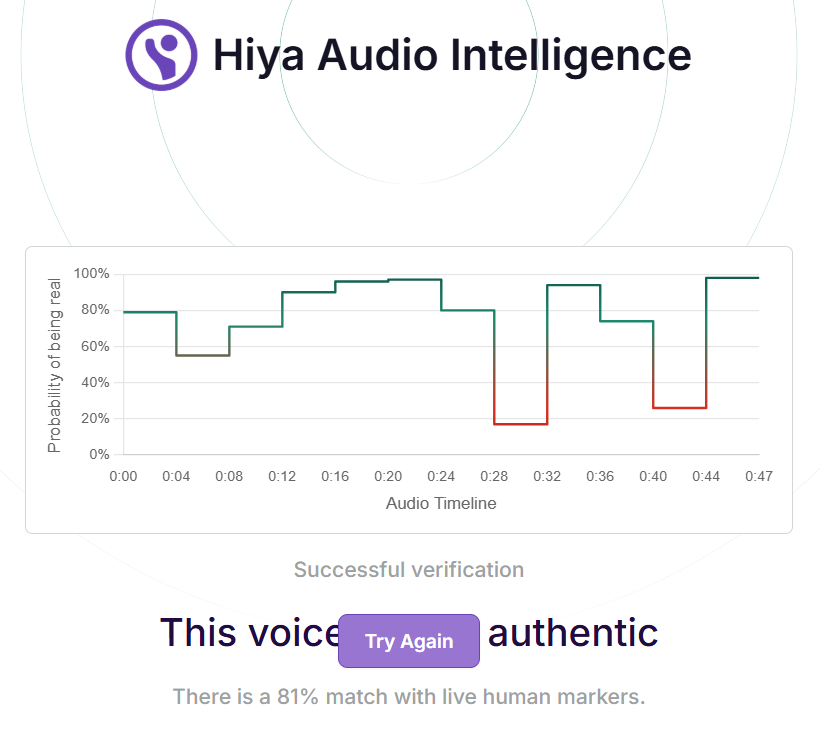
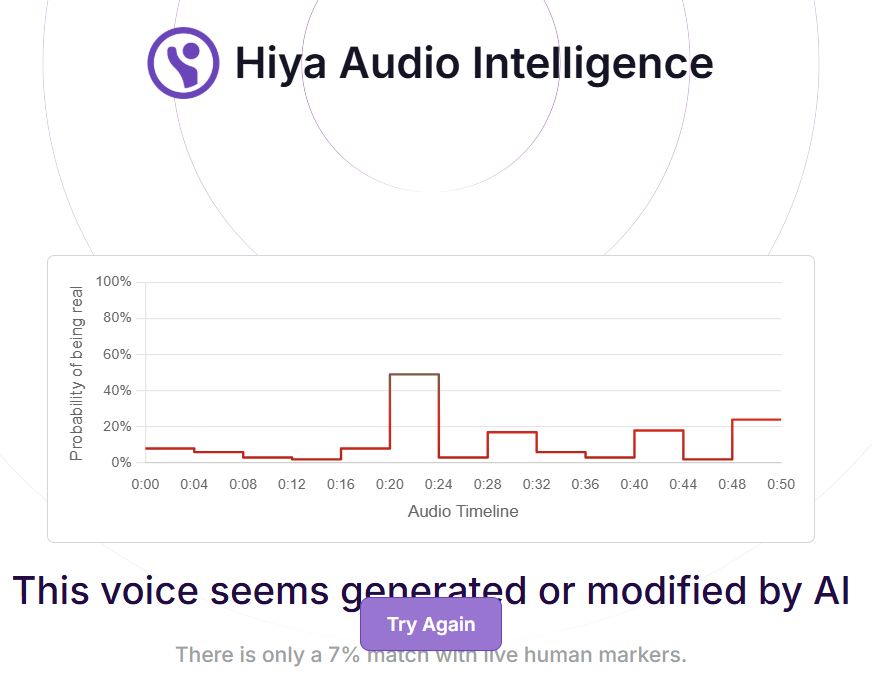
The voice tool of Hiya, a company that specialises in artificial intelligence solutions for voice safety, indicated that there is a 19 percent probability that the audio track in the video supposedly featuring Shah was modified or generated using A.I. The tool indicated that there is a 93 percent probability that the audio accompanying the general’s visuals has been modified or generated using A.I.
Hive AI’s deepfake video detection tool highlighted several markers of A.I. manipulation in Shah’s doctored video. For the video purportedly featuring the general the tool did not highlight any A.I. manipulation on his face but indicated manipulation on the face of the man standing beside him.
Hive’s audio detection tool found the entire audio track purported to be Shah’s voice as not A.I.-generated. Only 20 seconds of the audio track in the general’s doctored video was identified as A.I.-generated by the tool.


We also ran the audio tracks through the advanced audio deepfake detection engine of Aurigin.ai, a Swiss deeptech company. The results indicated that 10 percent of the audio track in Shah’s doctored video is A.I.-generated; and 91 percent of the audio track in the general’s doctored video is A.I.-generated.


We further put the audio tracks through the A.I. speech classifier of ElevenLabs, a company specialising in voice A.I. research and deployment. The results that returned indicated that it was “unlikely” that the audio track in the general’s doctored video was generated using their platform; and the classifier was “uncertain” that Shah’s purported audio track was created from the platform.
However, when we reached out to ElevenLabs, they noted that based on technical signals analysed by them they were able to confirm that the audio tracks in both the videos are synthetic or A.I.-generated.
To get expert analysis on the general’s manipulated video, we escalated it to the Global Online Deepfake Detection System (GODDS), a detection system set up by Northwestern University’s Security & AI Lab (NSAIL). The video was analysed by two human analysts and run through 22 deepfake detection algorithms for video analysis.
Of the 22 predictive models, 15 gave a higher probability of the video being fake and the remaining seven gave a lower probability of the video being fake.
In their report, the team noted that the subject’s mouth movements appeared stiff and awkward throughout the video. They corroborated our observations about the subject’s teeth, suggesting that they seem to change shape as he appears to speak. However they added that his bottom row of teeth seem to be the same size and shape, which they pointed to through several time codes throughout the video, identifying it as an unnatural and unlikely occurrence. They further stated that the subject’s teeth seemed to blur and merge together as they were obscured by mouth movements. They also pointed to a specific time code where the subject’s eyes briefly fade into the surrounding features.
The team also corroborated our observation about the man beside the general, noting that the subject on the left resembles the one in the center but has noticeably blurred eyes that appear unnatural. They consider this eerie similarity— moustache having the same colour and shape, eyebrows shaped and downturned the same way, gaunt cheekbones and same nose—to be suggestive of the use of face swapping technology.
In conclusion, the team stated that the video component is likely generated or manipulated via artificial intelligence.
To get an expert to weigh in on Shah’s doctored video we reached out to our partners at RIT’s DeFake Project. Kelly Wu from the project shared the same video that we traced as the source video. Ms.Wu highlighted the pattern on Shah’s scarf in the doctored video as a prominent artefact, adding that the rather complicated geometric pattern on it changes shape in the video.
Wu drew similarities between the changing patterns on the scarf with the distorted military insignia seen in several doctored videos of military officials that the RIT helped us debunk.
She pointed to a specific time code where Shah’s face seems to fade for a brief moment, which she suggests could possibly be a generation artefact. She noted that his teeth fluctuate between clear and blurry at various points in the video, an observation we pointed to above.
Saniat Sohrawardi from the project added that it’s typical of the type of manipulation seen on Shah’s scarf to struggle with physics and understanding how objects and materials should behave; it would have issues with keeping folds within clothing consistent with movements.
Mr. Sohrawardi explained that the pattern on the scarf would keep changing because material bending is not happening in this case. According to him, following the complex patterns across the video is the best bet at detection.
Sohrawardi points to specific time codes toward the end of the video to highlight how the scarf seems to protrude out like it’s Shah’s heart inflated; and states that the shape doesn't make sense with the corresponding body movement.
He makes a comparison between the body language in the doctored and the source video and notes that in the latter Shah can be seen looking at his notes a lot, and at the crowd with more intent during his speech. In the doctored video, however, the subject just looks at the crowd and seems to wing the speech.
He noted that the face morphing pointed out by Wu could also have been an artefact of the video editing done using the morph cut feature in Adobe Premiere, an editing software. That process can be used to join snippets of a video and if they are close enough the tool can blend some of the frames like an audio crossfade — a technique used to make smooth transitions between audio segments.
He considers this video to be better made than other similar ones since the creators behind it have tried to reduce the most obvious giveaways. Despite that, he added, they still left the scarf with a pattern that can be traced.
On the basis of our observations and expert analyses, we can conclude that original footage featuring the general and Shah was used with synthetic audio to peddle a false narrative about the Indian Armed Forces favouring a particular religion and ideology.
(Written by Debopriya Bhattacharya and Debraj Sarkar, edited by Pamposh Raina.)
Kindly Note: The manipulated audio/video files that we receive on our tipline are not embedded in our assessment reports because we do not intend to contribute to their virality.
You can read the fact-checks related to this piece published by our partners:
No, COAS Upendra Dwivedi Didn’t Say Army Will Reduce Non-Hindu Soldiers
Did Amit Shah Call Indian Forces ‘Army Of Hindutva’?
AI-Manipulated Clip Viral as Amit Shah Terming Indian Army as ‘Army of Hindutva'
COAS Dwivedi Said Army Reducing Non-Hindus by 50%? Video Is AI-generated


.png)