

.png)
The Deepfakes Analysis Unit (DAU) analysed two videos, one of them apparently featuring Gen.Anil Chauhan (Retd.), India’s former Chief of Defence Staff, and the other one supposedly featuring Gen.Upendra Dwivedi (Retd.), India’s former Chief of Army Staff. Both videos have one thing in common: the featured subjects seem to criticise Indian government policies around Operation Sindoor and praise the Pakistani establishment for their diplomatic and military strategy. After putting the videos through A.I. detection tools and getting our expert partners to weigh in, we were able to conclude that the videos were manipulated with synthetic audio.
Both videos are in English and were found embedded in posts on X, formerly Twitter. The one purportedly featuring General Dwivedi (Retd.) is 36-seconds long and was escalated to the DAU by a fact-checking partner. The other video that apparently features General Chauhan (Retd.) spans 57-seconds and was discovered by us during social media monitoring. One of the accounts carrying that video on X has now been withheld in India in response to a legal demand; we will refrain from sharing further details about the account. However, we were able to download the video before it was taken down.
The X account that posted the purported video of Gen.Dwivedi (Retd.) on May 31, 2026 goes by the display name of “XaQil-AI and Tools” and a display picture of a woman. The profile details suggest that the handle belongs to someone dealing with “AI tools, workflows and prompts for creators”, and is being run from “South Asia”. The text with the video in English, reads: “Due to failed policies of Central Government, India is doing nothing except sending Money (sic) to Taliban government. How can money alone do everything? – Army Chief General Upendra Dwivedi".
We do not have any evidence to suggest whether the suspicious videos originated from any account on X or elsewhere.
The fact-checking unit of the Press Information Bureau (PIB), which debunks misinformation related to the Indian government, posted fact-checks for the two videos – here and here – from their verified handle on X.
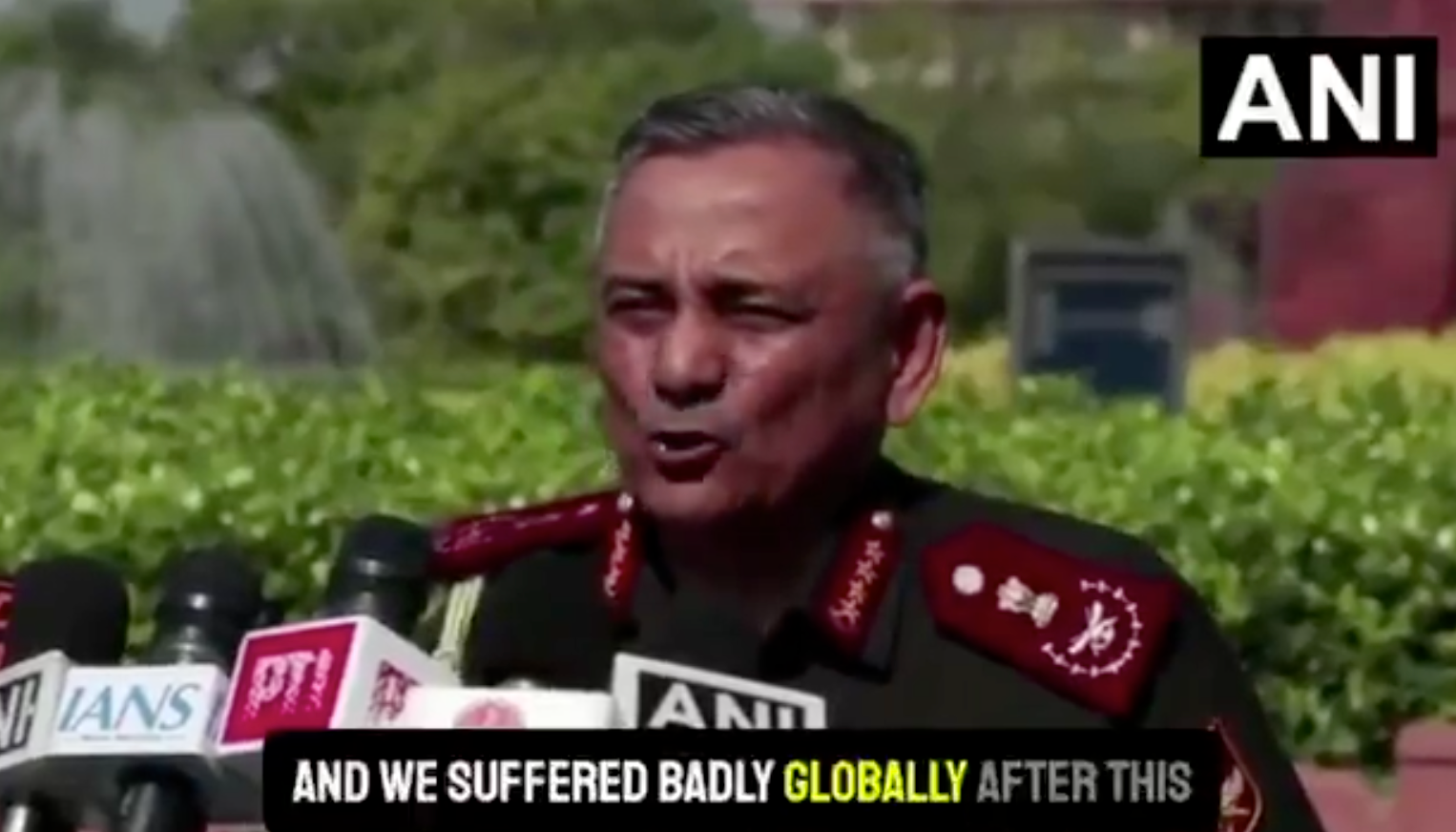
Gen. Chauhan (Retd.) has been captured in a medium close-up in his purported video. He appears to be standing and talking from an outdoor setting with lots of greenery and a fountain in the background. His foreground has an array of microphones bearing logos resembling those of Indian news agencies— ANI, PTI, and IANS. His head and gaze keep shifting from side-to-side giving the impression that he is addressing an audience. Another logo resembling an ANI logo is visible in the top-right corner of the video frame. Bold captions in white and yellow set against a black background, relaying the audio transcript, are visible at the bottom of the frame.
In the purported video of Gen.Dwivedi (Retd.), he too has been captured in a medium close-up but in an indoor setting seated on a chair and talking into a microphone. His backdrop comprises a wall, a flower pot is placed behind him. His head and gaze shift in different directions at frequent intervals, seemingly addressing an audience; the shoulder of another person is visible in the frame.
The overall quality of the two videos is poor. However, the synchronisation between the lips and the corresponding audio tracks is good for both videos. In Gen. Chauhan’s (Retd.) video his teeth seem to disappear in some frames and his mouth appears unnaturally dark as he appears to talk. The insignia on the uniforms of both the generals looks blurry.
We compared the voice attributed to each of the generals in the videos, with their respective recorded speeches and interviews available online. There is striking similarity in the voice, tone, and pitch in both sets of voices. However, the pronunciation of “Afghanistan” sounded odd in Gen. Dwivedi’s (Retd.) purported audio. And in Gen. Chauhan’s (Retd.) purported audio there is a filler word at the beginning of the video which sounds a bit abrupt. Overall, the pitch and delivery is sharper and vigorous for both the generals in their respective voice samples found online.
We undertook a reverse image search using screenshots from the two videos. Gen. Chauhan’s(Retd.) visuals were traced to this video published from the official X account of ANI on May 30, 2026; and Gen. Dwivedi’s (Retd.) visuals were traced to this video published from the official X account of PTI the same day.
The clothing, backdrop, and body language of the generals is identical in the videos we traced and the ones we reviewed. The audio tracks are in English in the videos we traced as is the case with the videos we reviewed, but the content is different. There is a reference to Operation Sindoor in Gen.Dwivedi’s (Retd.) source video, however, the context is not the same as that in his purported video.
An ANI logo is visible in Gen.Chauhan’s (Retd.) source clip in the top-right corner while in Gen.Dwivedi’s (Retd.) video a PTI logo can be seen in the top-right corner of the frame. The same logo at the same position is part of the doctored video of Gen.Chauhan(Retd.), however, the captions seen in that video are not part of the source video. The doctored video of Gen.Dwivedi(Retd.) has no logo. The insignia on the uniforms of both the generals is distinct in their respective source videos.
There is a filler word in the source video of Gen.Chauhan(Retd.), which is the same as heard in his doctored video, but it does not sound abrupt. The audio tracks in both source videos have a slight echo and ambient sound, none of which can be heard in either of the doctored videos.
It appears that a clip each from the source videos has been used as is to create the doctored versions, which look seamless with no visible jump cuts or transitions.
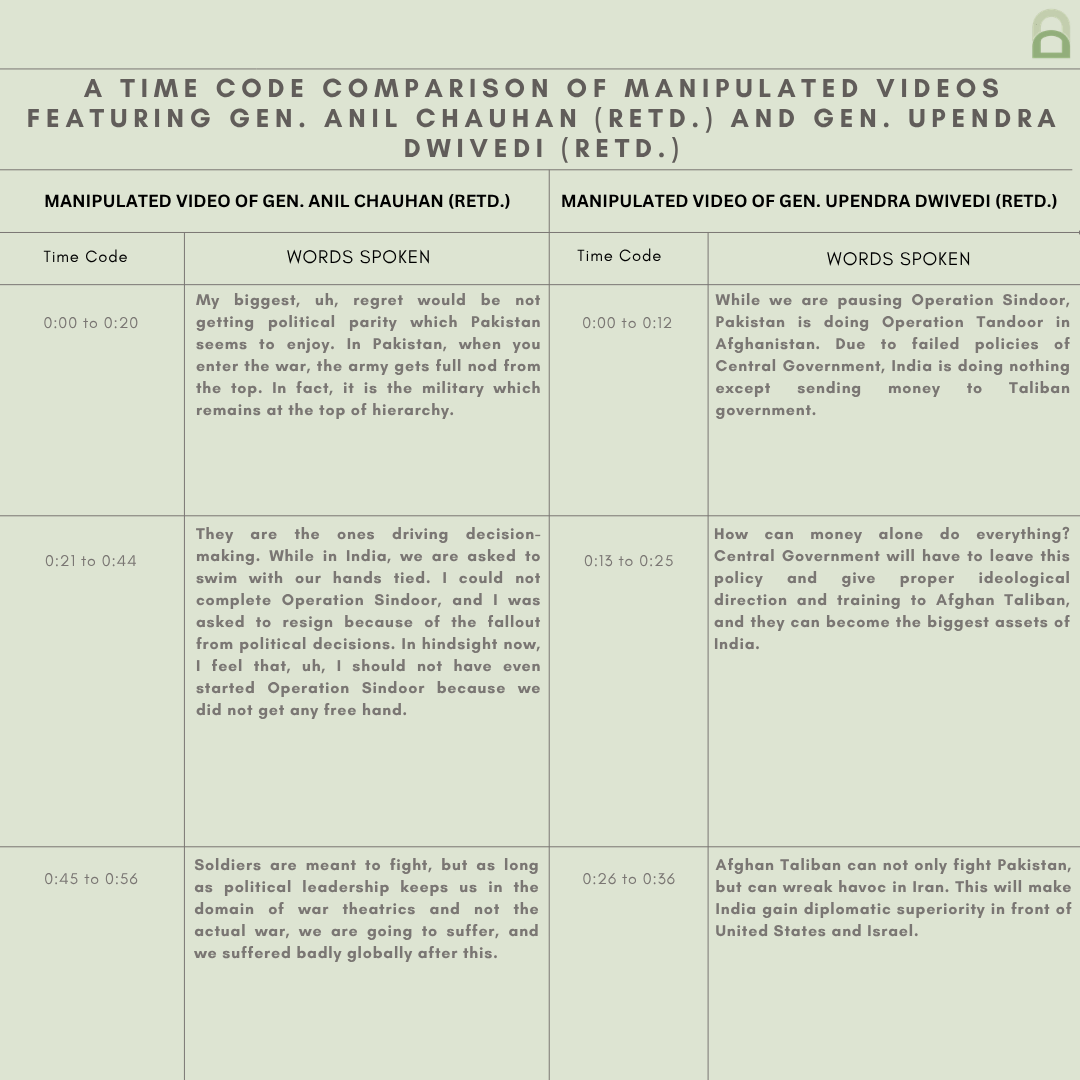
Shared below is a table that compares the transcripts of the audio tracks from the doctored videos. We want to give our readers a sense of how the audio tracks are being used to peddle a certain narrative. We, of course, do not intend to give any oxygen to the bad actors behind this content.
To discern the extent of A.I. manipulation in the videos we reviewed, we put them through A.I. detection tools.
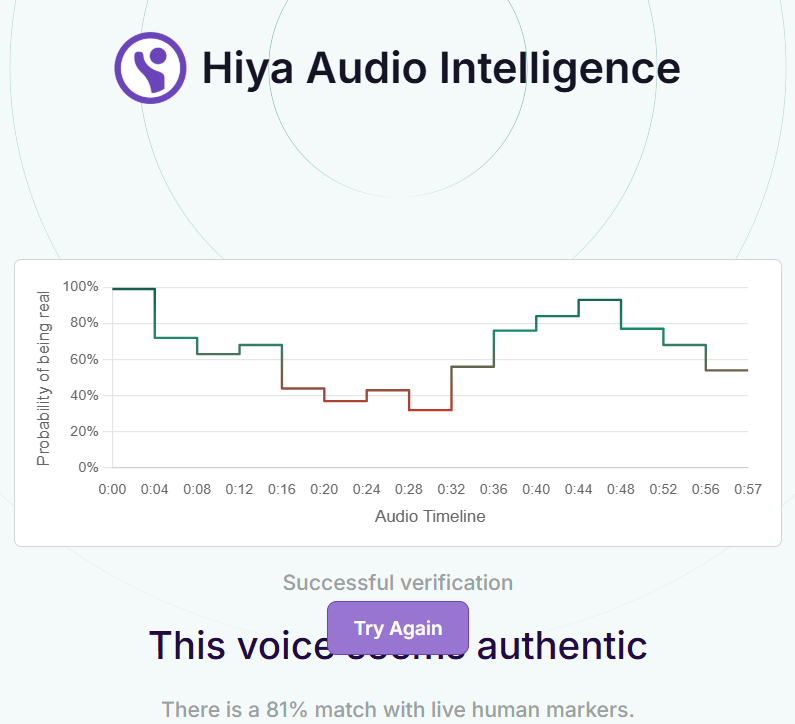
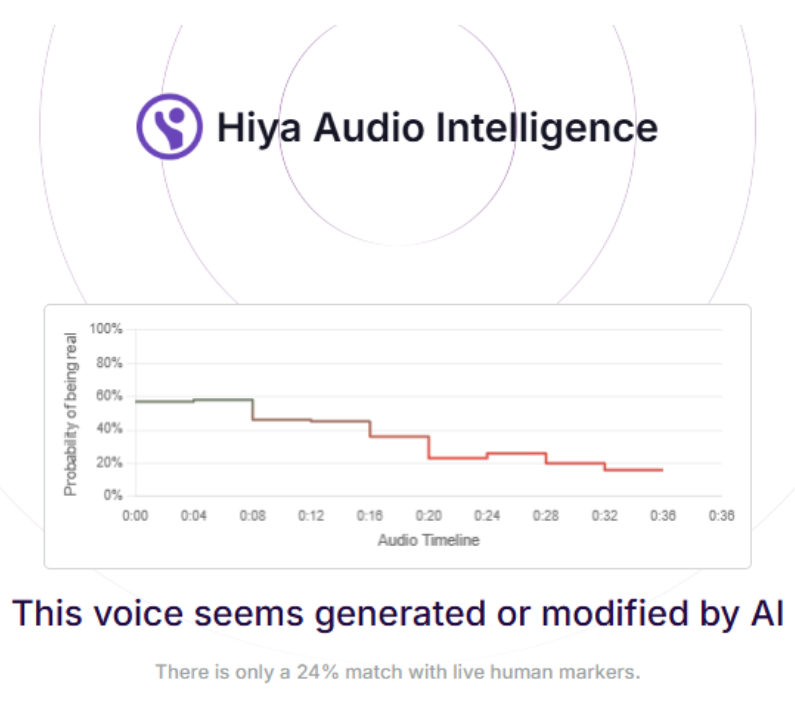
The voice tool of Hiya, a company that specialises in artificial intelligence solutions for voice safety, indicated that there is 19 percent probability that the audio track in the video purportedly featuring Gen. Chauhan (Retd.) was modified or generated using A.I. For the other video supposedly featuring Gen. Dwivedi (Retd.), the tool gave a 76 percent probability for the audio having been modified or generated using A.I.
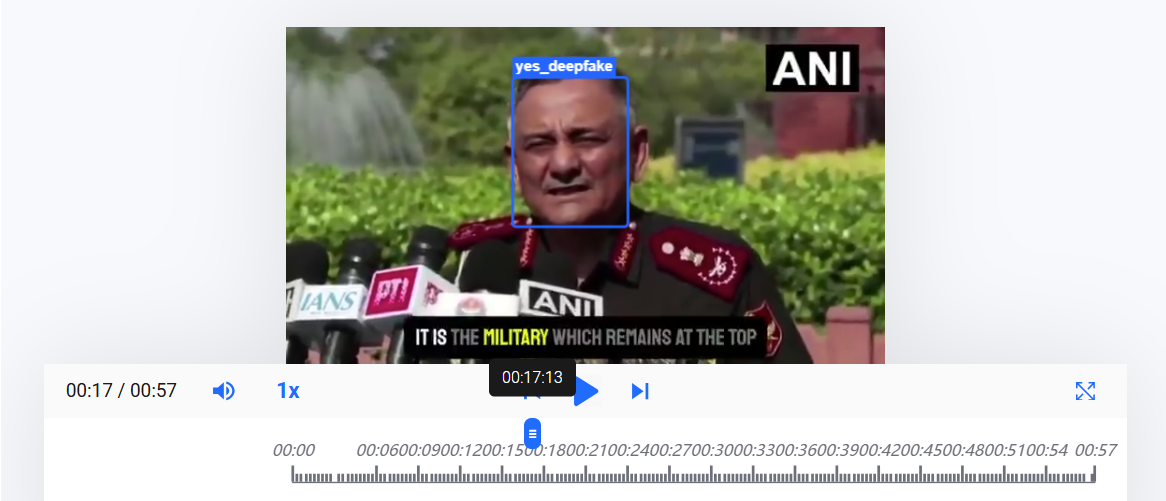
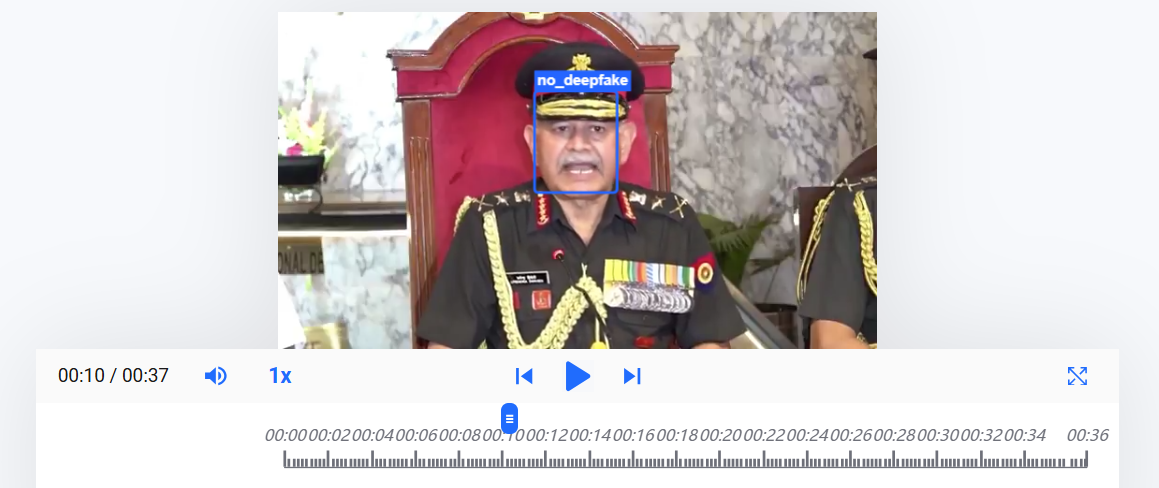
Hive AI’s deepfake video detection tool highlighted a few markers of A.I. manipulation in the doctored video of Gen. Chauhan (Retd.) but none in the doctored video of Gen. Dwivedi (Retd.). Their audio detection tool did not find any markers of A.I. in the audio tracks of the two manipulated videos.
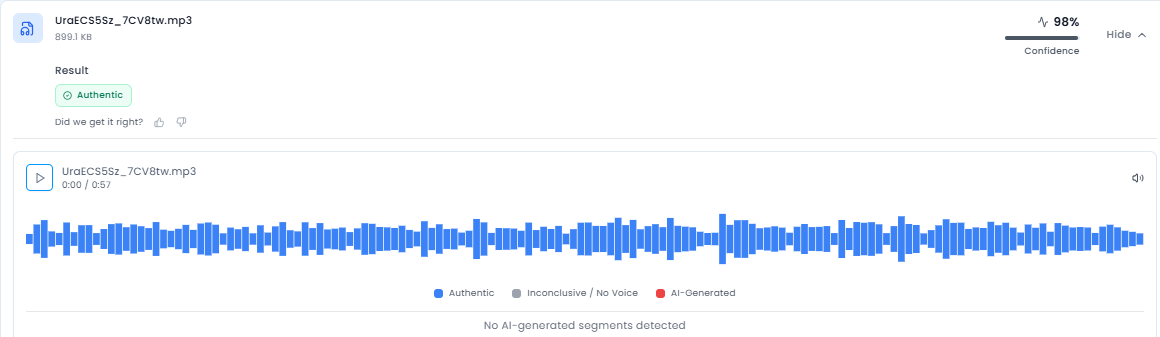
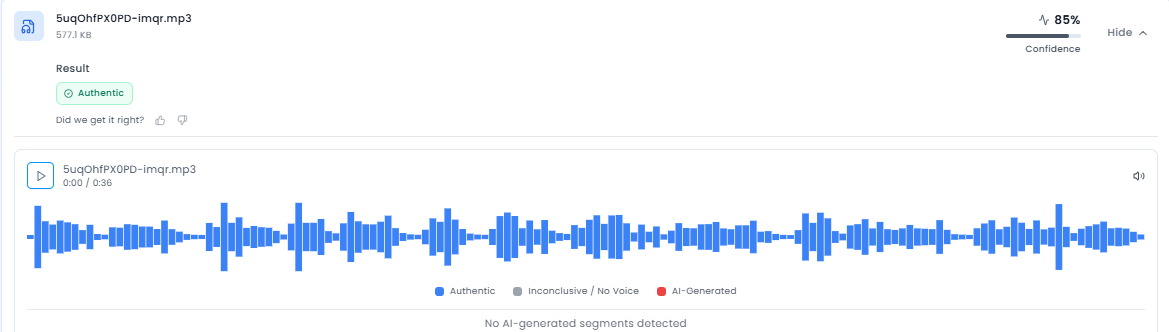
We ran the audio tracks through the advanced audio deepfake detection engine of Aurigin.ai, a Swiss deeptech company. The results indicated 98 percent confidence in the purported audio of Gen. Chauhan(Retd.) being authentic. The purported audio of Gen. Dwivedi(Retd.) was also categorised as authentic by the tool with 85 percent confidence.
We also put the audio tracks through the A.I. speech classifier of ElevenLabs, a company specialising in voice A.I. research and deployment. The results that returned indicated that it was “very unlikely” that the audio tracks in the videos were generated using their platform. A further analysis by the team also could not conclusively determine whether or not the audio tracks originated from their platform.
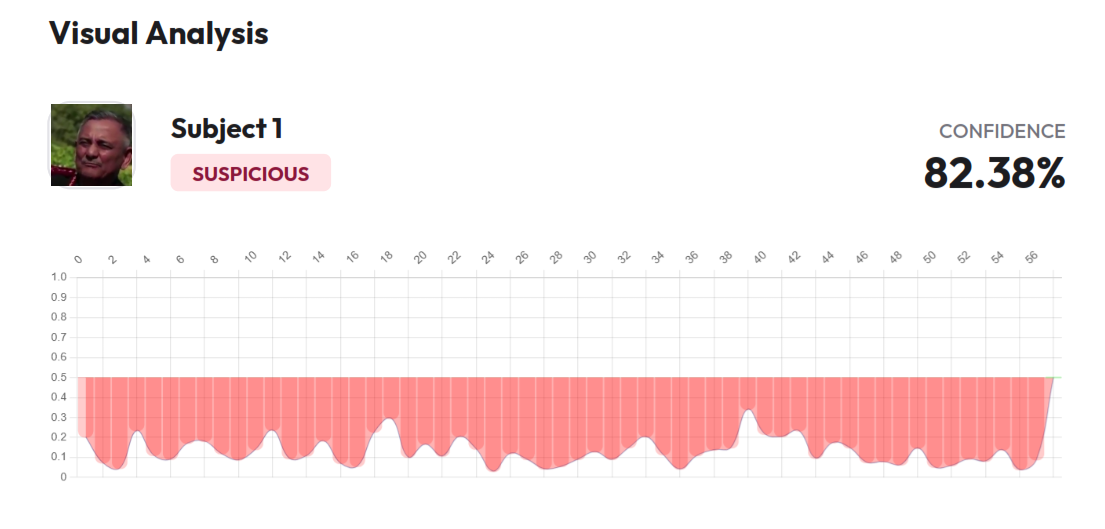
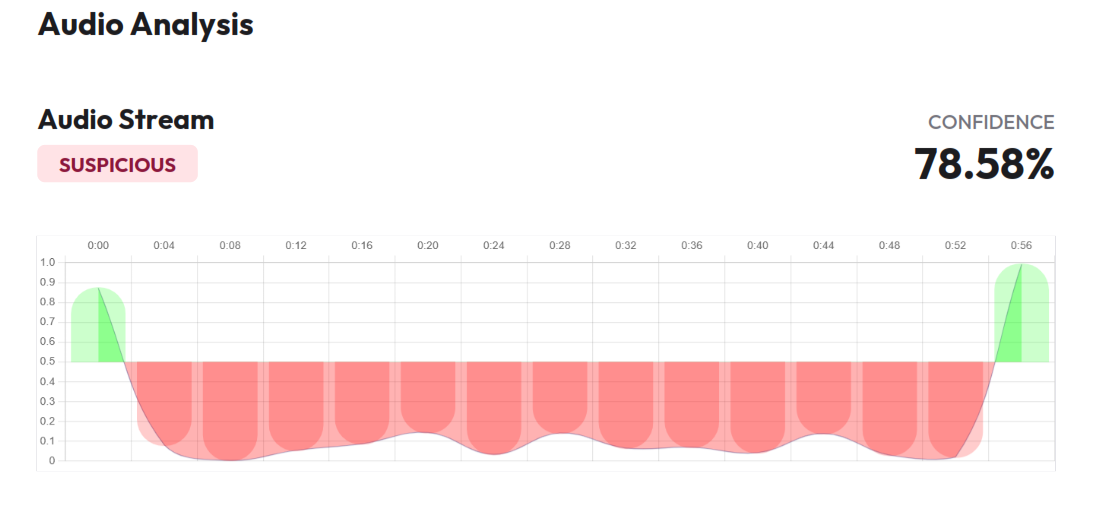
To get an analysis on the videos we reached out to ConTrails AI, a Bangalore-based startup with its own A.I. tools for detection of audio and video spoofs. The team ran both the manipulated videos through audio and video detection models. The results that returned indicated A.I. manipulation in the video tracks and signs of A.I.-generation in the audio tracks.
The team stated that in Gen. Chauhan’s(Retd.) doctored video, a lip-sync method seems to have been used to manipulate the subject’s mouth region and synchronise it with the audio track. They added that the lip movements are overly smooth as a consequence of the latest tools used in this media. They noted that voice cloning techniques were used in the audio track, which sounds highly monotonous, and that further indicates A.I. usage.
The team mentioned that for Gen. Dwivedi’s(Retd.) doctored video, the results were predicted with low confidence. However, they added that the context of the speech indicates high likelihood of A.I. use. They noted the likely use of voice cloning techniques for audio generation and the use of a lip-sync method to sync the subject’s mouth with the audio.
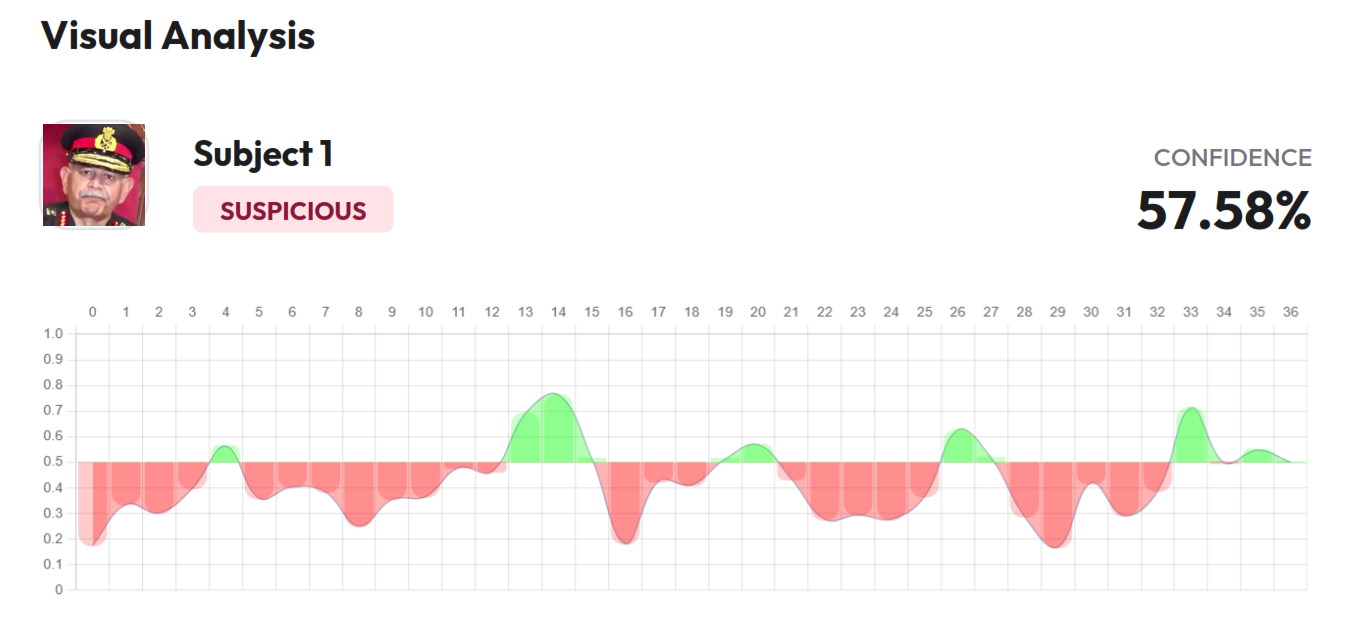
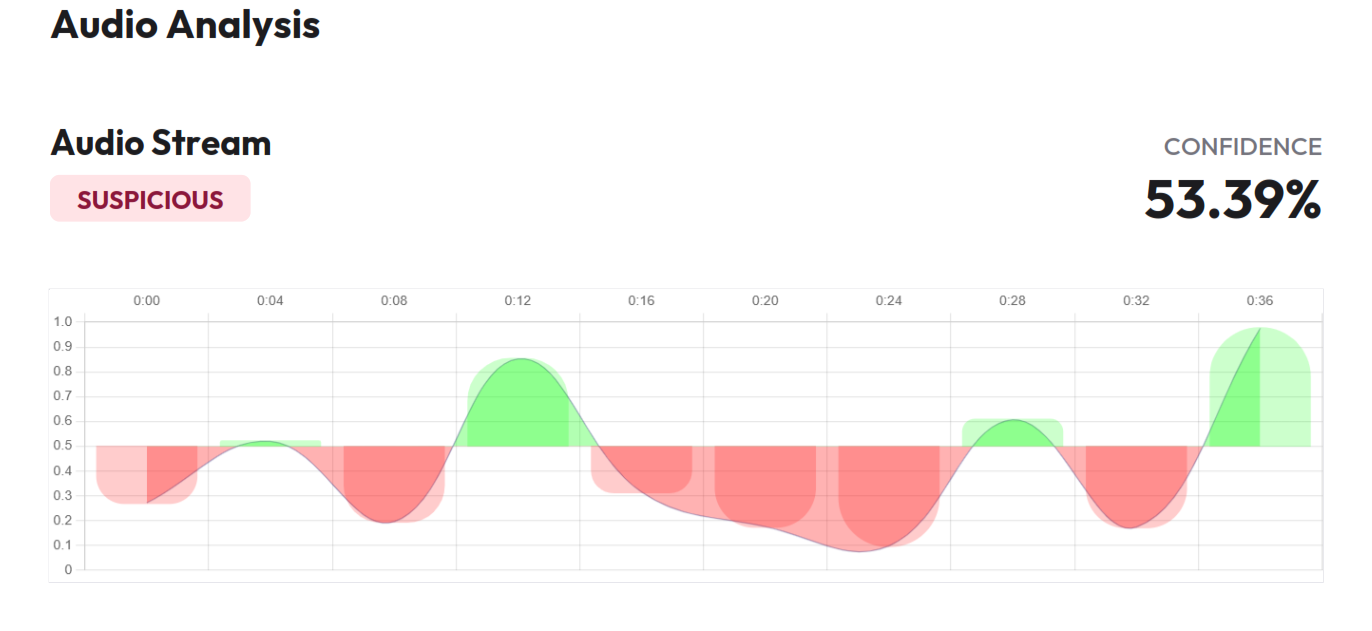
To get an expert to weigh in on the doctored video of Gen. Dwivedi(Retd.) we escalated it to the Global Online Deepfake Detection Systems (GODDS), a detection system set up by Northwestern University’s Security & AI Lab (NSAIL). The video was analysed by two human analysts, run through 22 deepfake detection algorithms for video analysis, and 70 deepfake detection algorithms for audio analysis.
Of the 22 predictive models, 10 gave a higher probability of the video being fake and the remaining 12 gave a lower probability of the video being fake. Of the 70 predictive models, 62 gave a higher probability for the audio being fake, while the remaining eight gave a lower probability of the audio being fake.
In their report, the team pointed to a specific time code where speech can suddenly be heard after a near-silent section, which indicates signs of digital audio processing. They highlighted another time code where audio re-enters abruptly at an unnatural timing. Pointing to yet another time code, the team explained that a near-silent lead-in is followed by a very clean and hard vocal onset.
They explained that the artefacts are largely obscured by the poor video quality. They added that it is difficult to discern possible artefact manipulation from the video’s heavy compression. They further noted that these indicators can likely be explained by other factors such as motion blur. In conclusion, the team stated that the video is likely manipulated via artificial intelligence.
To get further expert analysis on the doctored video of Gen. Chauhan(Retd.), we reached out to our partners at RIT’s DeFake Project. Kelly Wu from the project stated that many common artefacts that the team normally looks for in doctored videos are not very obvious in this one. Ms. Wu compared a version of the original video with the doctored video and noted that the blinking of the subject seems to match in the two videos; and the manipulation has happened only within the face area, particularly just the mouth region.
Wu highlighted that the video resolution is not the best, hence, looking at subtle details such as teeth rendering was challenging. She pointed to a potential artefact at a specific time code toward the end of the video— a bright white dot or pixel that seems to be lingering on the general’s lower lip as he appears to speak. She added that this could be due to the teeth rendering process, but could not be certain due to the video’s resolution.
Saniat Sohrawardi from the project explained that lower quality of videos masks and excuses a lot of artefacts, so the team often has to rely on biometric markers, where the A.I. models just misunderstand the behaviour of the speaker.
.gif)
Mr. Sohrawardi pointed to a moment in the video where Gen.Chauhan’s(Retd.) lips bend awkwardly in certain areas as well as other moments when he appears to lick his lips as he seems to pause while speaking. Sohrawardi noted that the A.I. model used for video creation just reanimated it into constant speech causing an inconsistency that couldn’t be hidden by compression. He stated that for videos like these, audio is very often the best tell.
On the basis of our observations and expert analyses, we can conclude that in each video original footage was used with synthetic audio to peddle a false narrative about senior Indian military leadership praising Pakistani policies and denouncing India.
(Written by Debraj Sarkar, edited by Pamposh Raina.)
(Kindly Note: The manipulated audio/video files that we receive on our tipline are not embedded in our assessment reports because we do not intend to contribute to their virality.)
You can read the fact-checks related to this piece published by our partners:
Deepfake Shared As Army Chief Criticising Central Government Policies
Altered Video of General Anil Chauhan’s Retirement Speech Goes Viral